
 Español
 Deutsch
 Français
 Italiano
 Português
 中文
 日本語
 한국어

Visitors
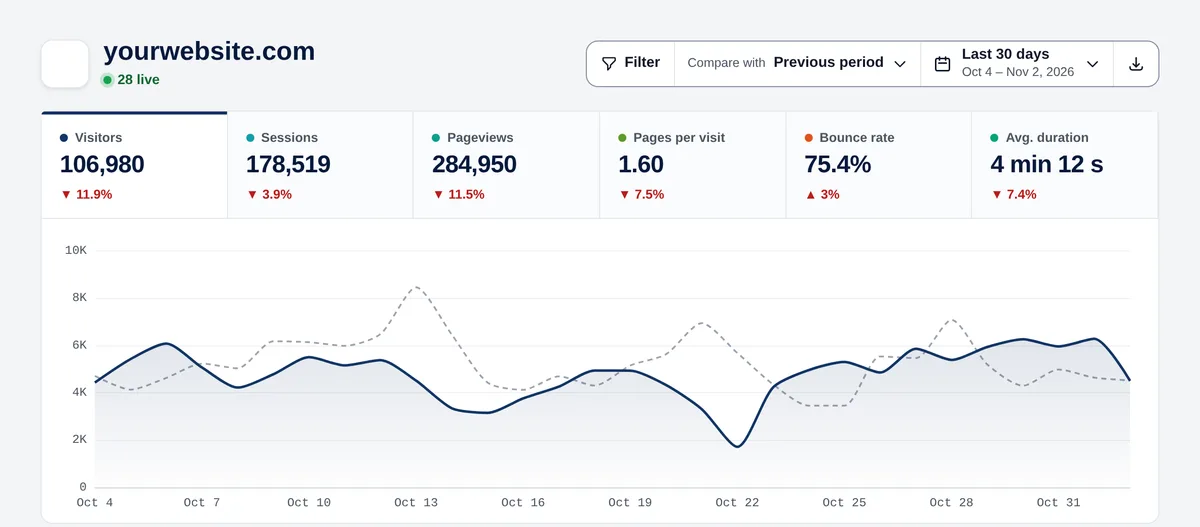
Unique people in the period. As there are no cookies, a visitor is recognised by a fingerprint: an irreversible hash of the IP address, the browser (user agent), its language and the website. The IP is not stored in your statistics; only the hash.
Sessions
A session is a visit: the pages a visitor views in a row. It ends after 30 minutes without activity; each new page restarts that countdown. If the same person comes back an hour later, that’s a new session.
Pageviews and pages per visit
Pageviews are the pages opened (a reload counts again). Pages per visit is pageviews divided by sessions: 1.6 means that, on average, each visit sees 1.6 pages.
Bounce rate
The percentage of sessions that viewed a single page. A 75% bounce rate means 3 out of 4 visits leave without opening a second page.
Tip: A high bounce rate isn’t always bad: on a blog article or a contact page, people often find what they need and leave. Compare it between pages of the same type.
Average visit duration
Time between the first and the last pageview of each session, averaged. Single-page sessions are left out, because without a second page there’s no way to know how long they stayed (that’s why it doesn’t drag the average to zero).
The change against the previous period
Every metric shows the percentage change against the comparison period: green if it improves and red if it gets worse. For the bounce rate, going down is improving. With “Compare with” you choose which period to compare.
Days and time zone
Days are counted in the time zone of Spain (Europe/Madrid). Data usually appears in the reports within seconds; the first data of a new website may take a few minutes.